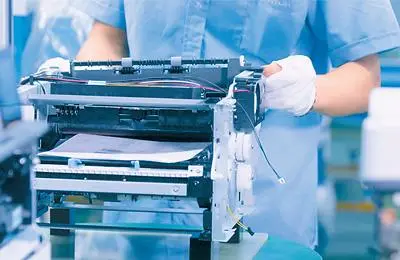
Printers: A Daily Essential with Complex Technology
As essential devices in daily life and work, printers are ubiquitous in homes, offices, and other settings. However, as a technology-intensive industry, the sheer number of patents, high technical barriers, and broad range of disciplines involved in printer development far exceed many people’s expectations.
In recent years, domestic printer manufacturers have continuously broken through technical barriers via sustained innovation, transitioning from reliance on external technologies to achieving full independent innovation. They have also established international competitive advantages in areas like intelligentization and 3D printing.
Why Is Printer Technology So Complex? How Did Chinese Manufacturers Achieve Breakthroughs?
The printer industry is a technology-intensive field. In May 2025, Bentu Electronics Co., Ltd. unveiled China’s first fully independent A3 laser copier at the Beijing Yanqi Lake International Convention Center. This innovation mastered core technologies in critical components such as printer engines, SOC main control chips, and LSU laser scanning units.
That same month, Hanin Electronic Technology Co., Ltd. showcased multiple 3D printing product lines integrating cutting-edge technologies at the Asia 3D Printing & Additive Manufacturing Exhibition, drawing global attention. In July, Xiaomi Corporation’s Mi Pocket Photo Printer 1S, which connects to smartphones for instant photo printing, officially hit the market.
A “Big Cake” in the Chinese Printer Market
According to an iMedia Consulting report, China’s printer market is projected to reach ¥40.84 billion by 2025. Faced with rising consumer demand, domestic manufacturers are entering the industry, launching high-quality products with independent intellectual property rights across niche sectors, earning consumer trust and market recognition.
Before the recent rise of domestic brands, China’s printer market was largely dominated by foreign companies, with core manufacturing technologies monopolized by international giants.
Why Were Printers Once a “Chokepoint” Challenge?
High patent barriers were a key factor. “Some foreign brands erected stringent patent walls, raising the industry’s technical thresholds. Leveraging decades of brand and channel advantages, they tightly controlled the market. Domestic manufacturers faced steep licensing fees or infringement risks,” said Zhang Xibei, head of Xiaomi’s ecosystem printer category.
Globally, over 100,000 valid printer-related patents exist, mostly held by U.S. and Japanese firms. These patents form an impenetrable “wall,” covering vast and intricate technical aspects.
Closed Supply Chains: Another Obstacle
“Printer manufacturers typically develop core components in-house or collaborate with exclusive suppliers, protected by extensive patents, creating closed supply chains,” explained Yin Aiguo, deputy general manager of Bentu. Early domestic manufacturers often struggled to access mature components.
Additionally, the industry’s complex product lines meant most parts were non-interchangeable, with high mold costs for new products. Building a complete domestic printer supply chain required massive investments in R&D across the entire lifecycle, further complicating breakthroughs.
Whole-Machine Manufacturing: Bridging Gaps Through Innovation
As critical devices for data input and output, printers connect to computers, tablets, or phones via drivers, posing multiple hidden data leakage risks. Without overcoming foreign dominance in whole-machine manufacturing, information security would remain vulnerable.
For Bentu, 2010 was a landmark year. “We launched China’s first A4 laser printer with independent core technologies and IP rights at the Great Hall of the People, filling a domestic void,” Yin recalled.
Looking back to 2007, Bentu’s parent company, Ninestar, had already become the global leader in printer cartridge production. Tasked with building a laser printer R&D team, Yin embarked on the journey of whole-machine development.
“Success is forged through perseverance,” Yin summarized. “Printers span dozens of disciplines, from precision mechanics to integrated circuits. As latecomers, we had to start from scratch—no mentors, no suppliers. After three years of dedicated R&D, we broke through hardware, software, chip, and data security barriers to debut China’s first self-developed laser printer.”
Today, Bentu operates a complete printer supply chain. In January 2025, its Hefei manufacturing base in Anhui Province began operations, complementing its Zhuhai laser printer industrial park to deliver an annual production capacity exceeding 6 million units.